

.webp)
.webp)

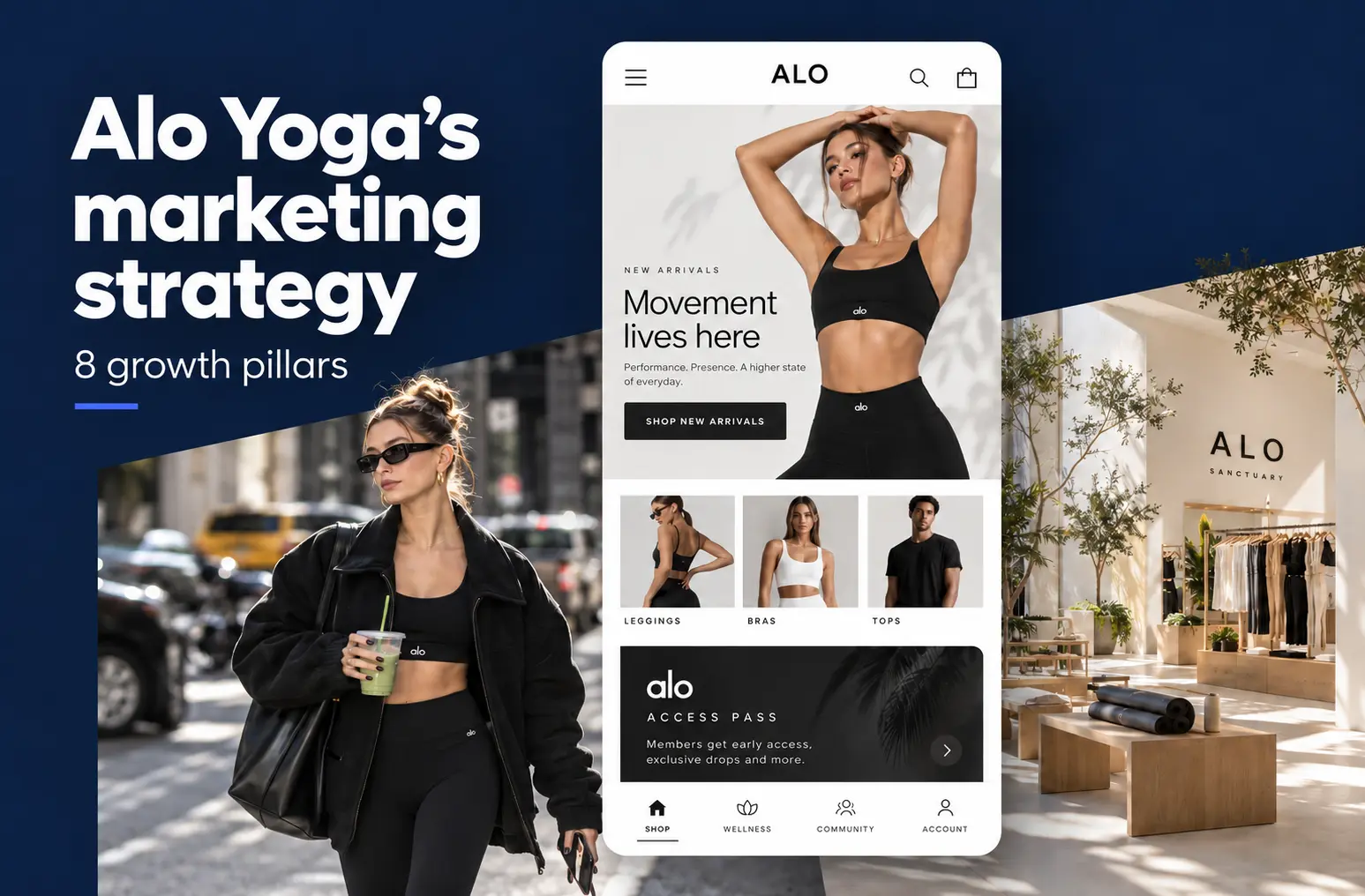
See how Alo Yoga’s 2026 marketing strategy uses influencers, stores, content, its mobile app, loyalty, and premium positioning to drive growth.
Nearly $2 billion in estimated revenue. Zero outside investors. Alo Yoga's marketing strategy gets credited to celebrity photos. But the real engine is an omnichannel system where creators, stores, the mobile app and the Alo Access loyalty program all push the same customer toward her next purchase.
From paparazzi shots of Hailey Bieber in limited-edition Airlift leggings to $32 mat Pilates classes above its stores, every channel feeds another one.
In this Alo Yoga case study, you will see the eight pillars behind that growth, how Alo turns celebrity attention into direct customer relationships, and which app and loyalty tactics you can use for your Shopify brand.
Key takeaways
- Alo is private and self-funded. Its founders have never taken outside investment, and Forbes estimates the parent company's revenue at nearly $2 billion for 2024.
- The website is the smaller half. Aloyoga.com generated an estimated $454M in 2025, so stores, the app and wholesale carry most of the business.
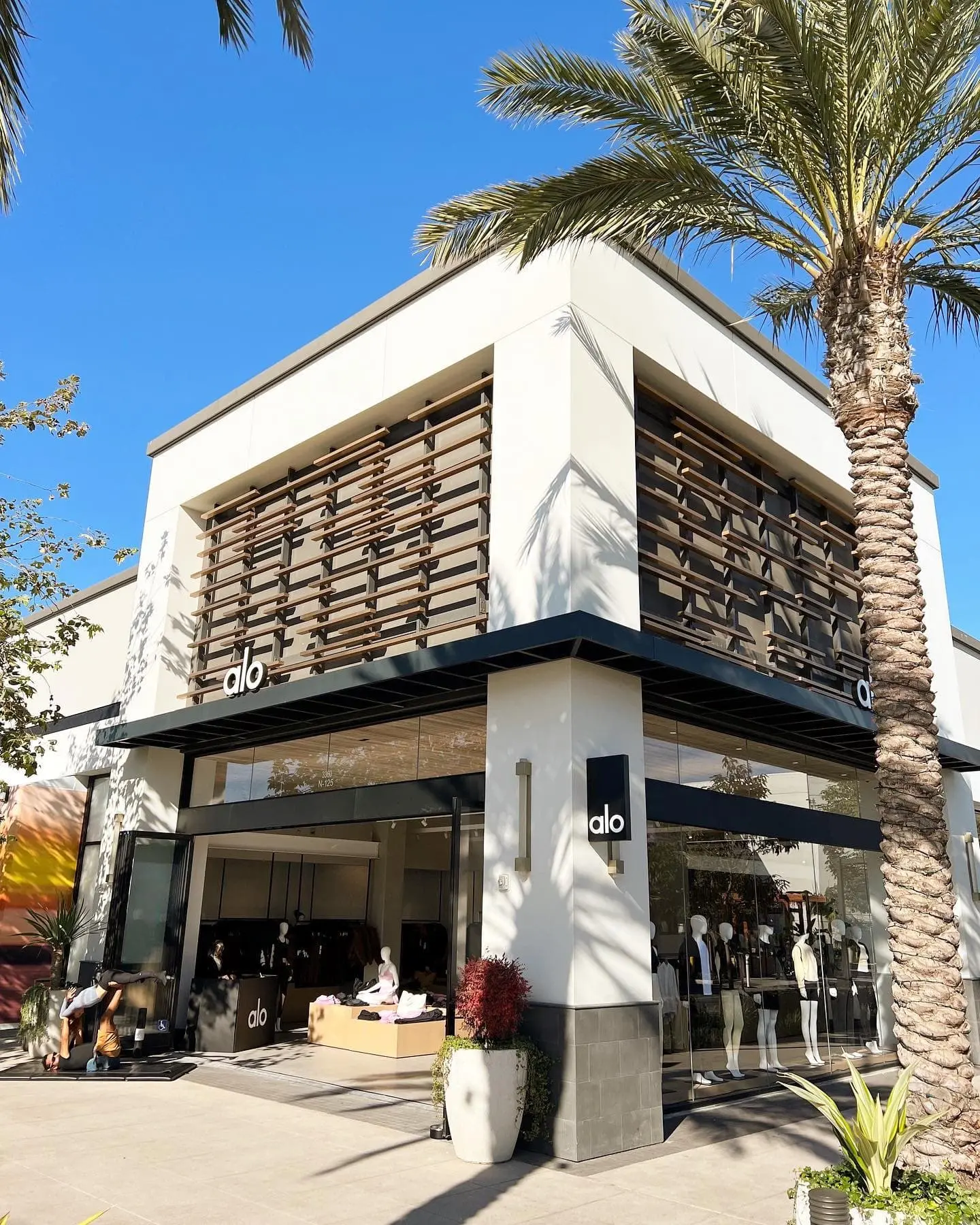
- Stores are a marketing channel. Alo runs 150+ stores worldwide, many with yoga studios called Sanctuaries.
- Creators do the heavy lifting. Alo published 30,200 sponsored creator posts in the last 12 months, more than Lululemon and Beyond Yoga combined.
- Retention is the weak spot. Alo customers are less likely to buy again than Lululemon's, which is exactly what the app and Alo Access are built to fix.
What is Alo Yoga's marketing strategy?
Alo Yoga's marketing strategy sells a wellness identity, not yoga clothes. Celebrities and creators generate demand. Sanctuary stores, on-demand classes, the mobile app and the Alo Access loyalty program capture that demand and bring the same customer back.
No single channel carries the brand. Each pillar feeds the next:
|
Pillar |
What Alo does |
Why it works |
What a Shopify brand can copy |
|
1. Celebrity seeding |
Gets product onto famous people in off-duty moments |
Reads as taste, not advertising |
Seed product with the 20 people your customer already follows |
|
2. Creator program |
Works with thousands of mostly small creators |
Volume beats one-off hero campaigns |
An always-on gifting and affiliate program |
|
3. Social content engine |
Reuses creator content across owned channels |
Low content cost, high output |
Usage rights plus shoppable UGC on product pages |
|
4. Sanctuaries and events |
Stores with yoga studios, classes and events |
Turns a store visit into a habit |
Pop-ups, community classes, local events |
|
5. Alo Wellness Club |
Free on-demand classes for loyalty members |
A reason to engage between purchases |
Members-only content that builds a routine |
|
6. Mobile app |
App-only drops, early access, fast checkout |
A VIP channel for the highest-intent customers |
A branded app with exclusive drops and push alerts |
|
7. Alo Access loyalty |
Free, tiered points program |
Turns repeat buying into status |
Tiered loyalty tied to access, not discounts |
|
8. Email, SMS and advertising |
Owned messaging plus paid amplification |
Pulls customers back into owned channels |
Push, email and SMS around every drop |
What makes Alo Yoga's business model special?
Alo didn't start as a yoga brand. It started as a T-shirt business. Danny Harris and Marco DeGeorge started the business in 1992 as a screen-printing and wholesale T-shirt operation. That company became Color Image Apparel, home to the blank-apparel brand Bella+Canvas.
Yoga came from personal history. DeGeorge had back surgery at age 11 and started doing yoga about a decade later, and it wasn't until 2007 that the pair launched Alo, short for Air, Land, Ocean.
How big is Alo Yoga in 2026? Revenue, stores and growth
Alo Yoga's revenue is estimated at close to $2 billion, but the brand publishes no financials, so every figure is an estimate. Third-party estimates range from $250 million to over $1 billion depending on the method.
|
Metric |
Estimate |
|
Parent company revenue (2024) |
Nearly $2 billion, mostly Alo |
|
Aloyoga.com revenue (2025) |
$454 million |
|
Projected online growth (2026) |
15–20% |
|
US share of online revenue |
83% |
|
Online revenue, August 2026 |
$45 million |
|
Stores worldwide |
150+, including 56 outside the US |
Sources: Forbes (2025), ECDB (2026). ECDB figures cover aloyoga.com only.
The website is the smaller half of the business. Even allowing for Bella+Canvas inside the parent's number, aloyoga.com's $454 million is well under half of Alo's sales. Stores, the app and remaining wholesale carry the rest. That gap is why Alo’s marketing is "omnichannel".
What are the 8 pillars of Alo Yoga's omnichannel marketing strategy?
Alo Yoga's marketing runs on eight connected pillars. Four create demand: celebrities, creators, social content and stores. Four capture and keep it: the Wellness Club, the mobile app, Alo Access and owned messaging. Each one pushes the customer toward the next.
1. Celebrity seeding makes Alo look chosen
Alo's celebrity strategy runs on paparazzi photos, not ad campaigns. Taylor Swift, Katie Holmes, Hailey Bieber and Kendall Jenner are regularly photographed in Alo while getting coffee, landing at airports and leaving the gym.
Alo runs an invite-only gym at its Beverly Hills headquarters where celebrities train in the brand's best-selling $100-plus leggings. A celebrity who works out at Alo is a celebrity who walks out in Alo.
On top of the candid shots, Alo runs paid ambassador campaigns, Kendall Jenner fronts the "Luxury Is Wellness" platform, Jisoo of BLACKPINK fronted the Spring 2024 collection, and Rosie Huntington-Whiteley leads programming in the Alo Wellness Club app.
2. A creator program at industrial scale
Celebrities make Alo famous. Thousands of everyday creators make it feel normal.
Alo does not wait for a seasonal campaign to work with creators. Modash analysed 30,200 pieces of Alo-sponsored creator content published over 12 months, equal to roughly 2,500 posts a month.
|
Alo vs rivals (last 12 months) |
Sponsored posts |
|
Alo Yoga |
30,200 |
|
Lululemon |
18,900 |
|
Beyond Yoga |
1,100 |
Source: Modash (Sep 2026)
How the Alo’s creator program is built:
- Instagram first: 84.9% of sponsored posts run on Instagram, 14.6% on TikTok and 0.5% on YouTube.
- US-heavy: 38% of creator content comes from American creators, followed by Brazil and the UK.
- A long-term core: 456 creators (4%) posted for Alo in three or more separate months, and the most consistent partner posted 77 times across 13 months.
That gives Alo two advantages. It learns which creators fit the brand over time, and customers encounter the product through many different people. Repetition makes the brand feel established before a shopper ever visits the website.
3. A social content engine
Alo treats creator posts as raw material. The best of them flow into "Styled By You" on Alo's site and app. It shows real customer and creator outfits as clickable photos tagged with the exact products, with everyday fans sitting next to names like @kendalljenner.
[Image: "Styled By You" section in the Alo app. Picture Source: Appbrew]
Why it works: every creator post does two jobs. It earns reach on the creator's feed, then works as social proof on the product page, right where the shopper is deciding.
4. Stores work as media, studios and community spaces
Alo has more than 150 stores worldwide, according to Forbes. Many locations sit in high-spend neighbourhoods, and some include yoga studios called Sanctuaries. These stores sell, but they also generate content, host classes like Alo Mat Pilates at $32 and make the brand tangible.
Beyond the stores, Alo runs New York Fashion Week wellness programming, free International Women's Day classes across nine countries, and retreats like the Alo Moves Retreat in Los Cabos.
Why it works: a store that hosts a weekly class gets weekly visits. Every visit is another chance to sell, without paying for the traffic.
5. Alo Wellness Club: free classes in exchange for loyalty
In late 2025, Alo gave its paid fitness app away. Alo Moves, which Alo built after acquiring the fitness app Cody in 2017, used to cost $129 a year.
Alo relaunched it as Alo Wellness Club and removed every paywall for Alo Access members. The library holds more than 4,000 classes and 300 programs across yoga, Pilates, strength and mindfulness. It's rated 4.9 stars from 35,000 reviews on the App Store.
Why it works: Alo swapped subscription revenue for something more valuable: a reason to open an Alo app every day. Each class is a free brand touchpoint, and each signup is a new loyalty member with an email address attached.
6. The mobile app as a retention channel
Alo's shopping app doesn't copy the website. It sells access. We downloaded the app and went through it screen by screen. Here's what stands out.
6.1 Early access and exclusive drops.
When you open the Alo app for the first time and you don’t just get a login screen, you get an initiation. Instantly, you’re handed perks that feel like a backstage pass.
.webp)
The app offers:
- App-only discounts and promotions
- Early access to new drops
- Exclusive app-only launches
- Real-time push alerts so users never miss a drop
6.2 Shoppable "Styled By You" galleries.
Customer and creator photos sit inside the app, tagged with the exact products. Shoppers see how pieces look on different bodies before they buy.
.webp)
6.3 Frictionless checkout.
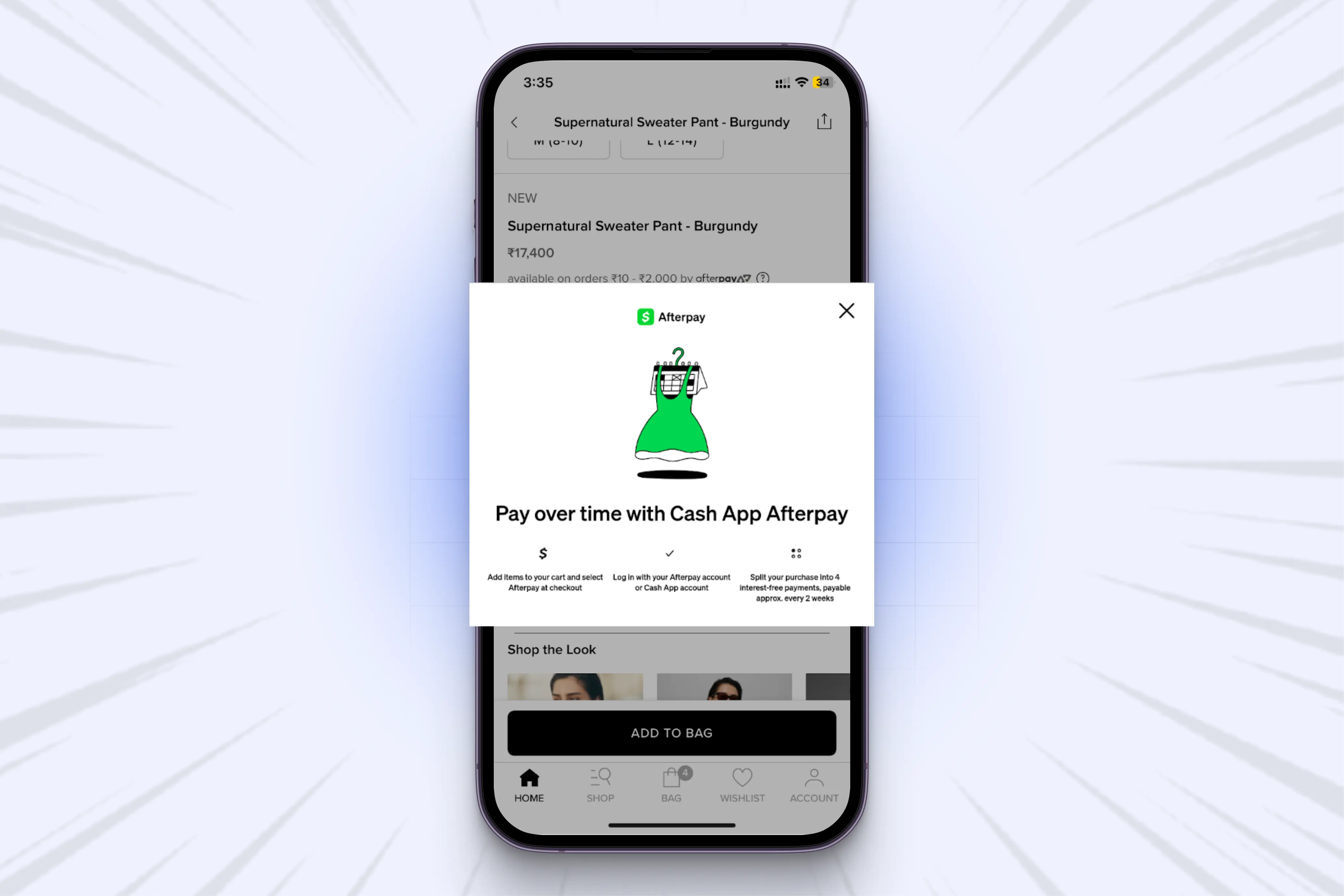
Apple Pay, PayPal and Amazon Pay offer one-tap payment, Afterpay covers installments, and saved account details remove form filling.
6.4 Sticky add-to-bag and Quick Shop.
The add-to-bag button follows the shopper down every product page, and Quick Shop adds items straight from the product grid without opening a new page.
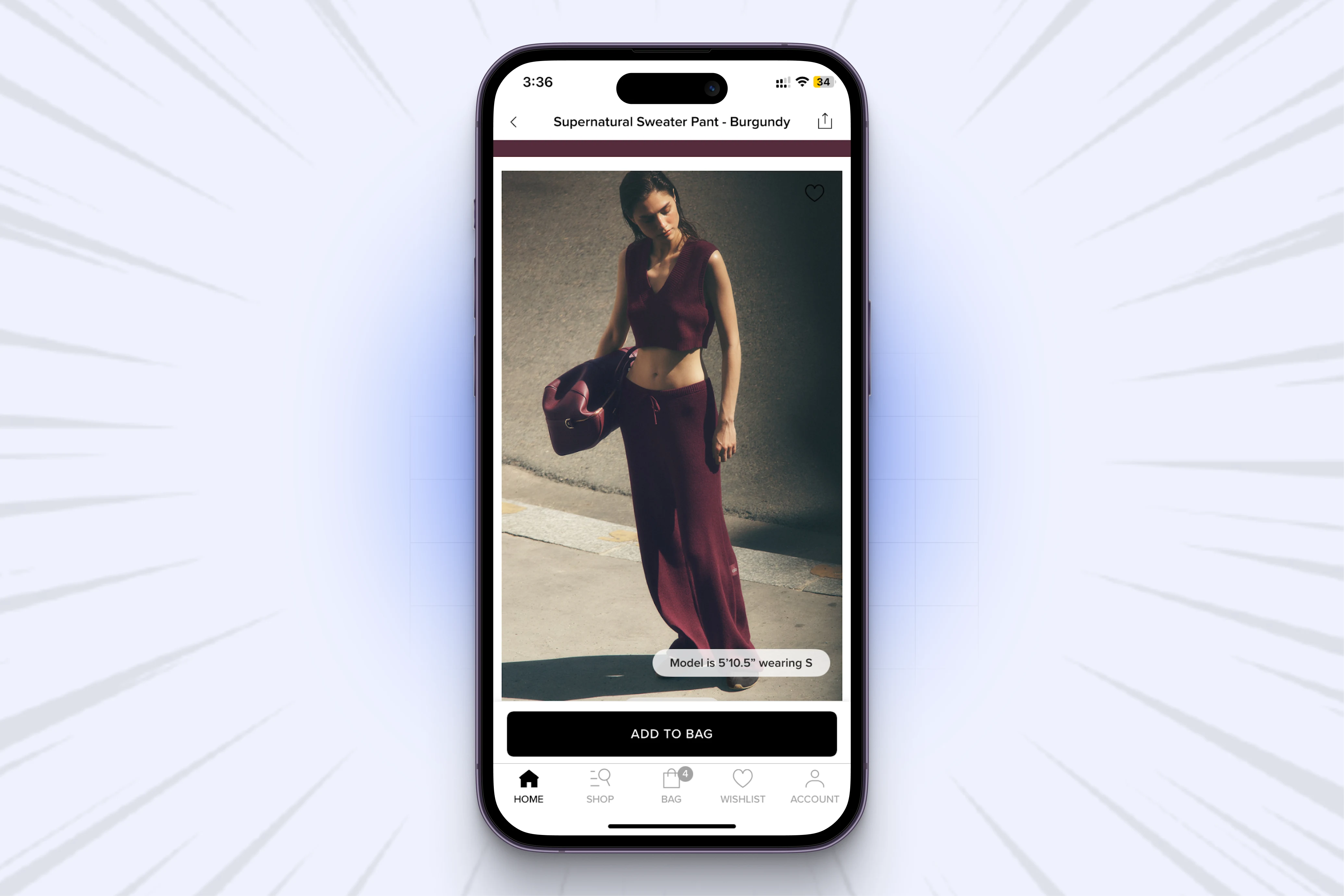
Alo has clearly thought through the small moments that break a shopping flow. On both the app and the site, the buying action is never out of reach.
Why it works: the app is where Alo's most engaged customers live, and every feature is built to remove one more reason to leave. It's also Alo's answer to its biggest weakness. Alo customers are still less likely to buy again than Lululemon's, and a VIP channel with drop alerts is built to fix exactly that.
{{cta}}
7. Alo Access: the loyalty program
Alo Access is free to join and turns spending into status. Members earn 1 point for every $1 spent, online or in stores, and climb three tiers:
|
Tier |
Points (12 months) |
What members get |
|
VIP |
0–299 |
Welcome gift, birthday gift, member-only sales, free Alo Wellness Club access |
|
A-List |
300–999 |
All VIP perks, plus priority access and extra rewards |
|
All Access |
1,000+ |
All A-List perks, plus invite-only experiences and a private Instagram account |
Sources: Alo Yoga terms of use, Points Insider, BLOY (2026)
Status resets every year. Members who don't requalify within 12 months drop back to VIP, so the best customers keep a reason to spend all year.
Rewards are products, not discounts. Points redeem for curated Alo merchandise, worth roughly 6–7% back, which protects full-price positioning in a way coupon codes never could.
Why it works: top-tier perks money can't buy make All Access feel like a club. And because the Wellness Club is free only to members, Alo Access now attracts people before their first order.
8. Email, SMS, paid media and category launches
Alo's owned messaging is built around drops. Alo added SMS in August 2023, and within months it drove 4% of revenue. Its first findings shaped the whole program. Younger shoppers preferred texts to email, and one of the best-converting audiences was loyalty members who wanted early access to new colors.
Advertising plays a supporting role. Most visits to aloyoga.com come from people typing the URL or searching the brand name. Paid search ranks third, behind direct and organic. Celebrities, creators and stores create the demand; paid ads mostly catch it.
Category launches keep the messages fresh. Skincare in 2020, formalwear and sneakers in 2023, handbags in 2025: each new category is another reason to text, email and push.
Why it works: a brand that launches something new every few weeks never has to send a generic "20% off" email. The drop is the message.
The pattern for a Shopify operator to notice: Alo spends heavily to win attention, then works just as hard to move it into channels it owns. Celebrities, creators and stores bring customers in. The app, Alo Access and the Wellness Club keep them.
Who is Alo Yoga’s target audience?
Alo Yoga’s target audience is affluent, wellness-focused women aged 25–34, along with upper-income teens who aspire to the same lifestyle.
As Sky Canaves, principal analyst at Emarketer, told Reuters: "Alo is a little more exclusive and higher end with stronger ties to luxury that really speak to the affluent or highly aspirational consumer."
|
Audience snapshot |
|
|
Gender |
68% female, 32% male |
|
Core age group |
25–34 |
|
Top market |
United States, 59% of site traffic |
|
Store locations |
Neighbourhoods with 29% higher consumer spend than Lululemon's |
|
Shopper overlap |
63% also shop at Lululemon |
Sources: Similarweb and PassBy, 2026
Alo’s audience includes:
- Affluent wellness women. She treats yoga and Pilates as part of who she is and has the budget for $134 leggings. Alo opens stores where she lives.
- Upper-income teen girls. By Fall 2025, Alo was the No. 6 brand worn by upper-income teen girls in the US, up 12 spots in a year.
- Lululemon shoppers. Six years after their first Alo purchase, Lululemon customers spend $660 a year at Alo and $600 at Lululemon.
- Gen Z and Gen Alpha gamers. Alo's Roblox world has drawn over 117 million visits since 2022.
Alo's real challenge is the second purchase. Its customers are still less likely to buy again than Lululemon's. Winning attention is the part Alo has mastered. Keeping customers is what the app and Alo Access are built to do.
The lesson for you: target an aspiration, not an age group. Alo uses Roblox and creators to build desire early, then relies on stores, its app and loyalty program to retain customers once they can afford the lifestyle.
How does Alo Yoga position its brand?
Alo Yoga's brand positioning is simple: a wellness lifestyle brand that happens to sell activewear. Its branding rests on four ideas: clothes designed "studio-to-street" for the whole day, wellness framed as the new luxury, premium prices as a status signal, and mindful movement with a purpose.
|
Positioning idea |
Where it shows up |
|
Studio-to-street |
Product design, off-duty celebrity photos |
|
Luxury is wellness |
Skincare (2020), Alo Atelier formalwear (2023), $3,600 handbags (2025) |
|
Premium price as status |
$134 leggings, flagships in luxury neighbourhoods |
|
Mindful movement |
Sanctuary studios, Alo Wellness Club, free community classes |
What are Alo Yoga's biggest marketing campaigns?
Alo's biggest campaigns don't sell a product. They sell a setting. A desert resort in Utah, a superyacht in Cannes, a virtual studio in Roblox. Each one puts Alo inside a world its customer wants to belong to, then gives her something to buy on the way out.
Alo Yoga's marketing campaigns, year by year:
|
Year |
Campaign or moment |
What it did for the brand |
|
2021 |
Official wellness partner of New York Fashion Week |
Put yoga, sound baths and breathwork inside fashion's biggest week |
|
2022 |
Alo Sanctuary on Roblox |
Opened the brand to Gen Z and Gen Alpha, with over 117 million visits since |
|
2023 |
First sneakers and a London flagship on King's Road |
Moved Alo beyond apparel and into Europe |
|
2023 |
Alo Atelier formalwear |
First step into luxury ready-to-wear |
|
2024 |
Jisoo of BLACKPINK fronts the Spring collection |
Expanded reach across K-pop and Asian markets |
|
2025 |
First Asian flagship in Seoul |
Turned that K-pop reach into a physical destination |
|
2025 |
"Luxury Is Wellness" with Kendall Jenner |
Made wellness the brand's version of luxury |
|
2025 |
Italian leather handbags up to $3,600 |
Took the luxury idea into accessories |
|
2025 |
Alo Moves relaunched as the free Alo Wellness Club |
Traded subscription fees for daily engagement |
|
2026 |
Free classes in nine countries for International Women's Day |
Backed the brand's purpose with real community programming |
|
2026 |
"Alo Voyage: Wellness Club at Sea" on the French Riviera |
Launched Alo in France with a superyacht at Cannes |
Sources: Retail Dive, SGI Europe, Business of Fashion, WWD, Net Influencer (2024–2026)
"Luxury Is Wellness" with Kendall Jenner (2025)
“Luxury Is Wellness” is the clearest expression of Alo’s current positioning. Kendall Jenner selected existing Core Collection pieces she had worn before, and the campaign unfolded in chapters with new color drops. Alo used one idea to refresh proven products across several months.
"Alo Voyage: Wellness Club at Sea" (2026)
“Alo Voyage” used a much louder approach. The brand chartered a superyacht during the Cannes Film Festival, filled it with wellness treatments and creator activity, and connected the attention to new stores in Cannes and Saint-Tropez. The expense drew criticism, but it made Alo hard to miss during two of Europe’s most photographed weeks.
Roblox and "Move Into Wellness" (2022–2024)
Alo built a store for customers who can't afford it yet. Its Roblox Sanctuary, later upgraded with a gym, cold plunge and meditation spaces for the "Move Into Wellness" campaign. The virtual Sanctuary lets the brand build recognition before those customers enter its core market.
The pattern for a Shopify operator to notice: Alo never runs a campaign that ends when the ads stop. "Luxury Is Wellness" became three months of drops. The yacht came with permanent stores. Roblox links back to physical locations. Every campaign hands the customer a next step.
8 marketing lessons you can steal from Alo Yoga in 2026
You don't need Kendall Jenner or a superyacht to use Alo's playbook. Most of what works for Alo is a system, and systems scale down.
1. Seed product with the people your customers copy
For a Shopify brand, that isn't a celebrity. It's the 20 local instructors, stylists or creators your customer already follows. Gift generously and let them wear it on their own terms.
2. Run an always-on creator program
Replace one-off campaigns with a steady flow of gifting and affiliate partners, most of them small. Require clear "#ad" disclosure on every post; Alo's lawsuit shows what skipping it can cost. It's the same engine behind the Gymshark marketing strategy.
3. Put creator content on your product pages
Get usage rights and add shoppable customer and creator photos to your product pages, the way Alo's "Styled By You" gallery does. Social proof works best at the moment someone is deciding.
4. Give customers a reason to visit, not just to buy
Pop-ups, community workouts or local meetups do what Alo's Sanctuaries do, at a smaller scale. A customer who shows up every week buys more than one who only shows up at checkout.
5. Use free content to grow your loyalty program
Alo turned a $129-a-year fitness app into a free perk for loyalty members. Your version might be guides, tutorials or a members-only content hub. Free value in exchange for a signup gives you a customer you can reach again for free.
6. Make your mobile app a VIP experience
Alo's biggest problem isn't winning customers. It's winning them twice. That's the gap the Alo app is built to close, with early drops, app-only launches, push alerts and one-tap checkout.
You don't need Alo's engineering budget to build the same channel. Alo's website runs on Shopify, and so does yours, which means the same app layer is within reach. Appbrew turns your Shopify store into a native iOS and Android app, synced with your products, loyalty program and customer data.
US brands that already made the move:
- Svaha USA (apparel): 43% repeat purchase rate on the app, compared with 31.3% on the web. That's Alo's second-purchase problem, solved by the channel.
- Kut from the Kloth (denim): 5.4% app conversion vs 2.3% on the web, 19x longer engagement, and app customers worth 10x the lifetime value of web-only shoppers.
- Dermaclara (skincare): 32% higher conversion rate, 3.5x growth in app revenue and 5.5x more engagement after switching to Appbrew.
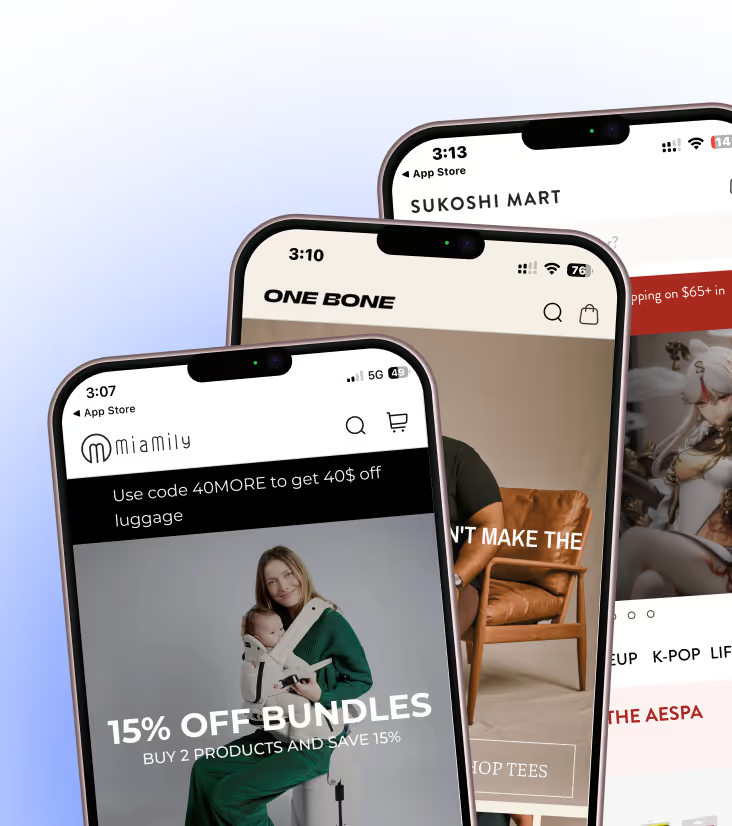
- Sukoshi Mart (beauty): 30% higher conversion rate after switching from another app builder, and 45% more customer data captured.
If Alo's playbook proves anything, it's that attention is rented and the app is owned. None of these brands needed a celebrity. They needed a channel their best customers open every week.
7. Build loyalty around access, not discounts
Reward customers with status, early access and real products, not blanket coupons, and make your top tier re-earned every year. Then put the program where customers see it: Dermaclara surfaces its loyalty rewards inside its app, so members see their points every time they shop. For a beauty-brand example, see our breakdown of e.l.f. Cosmetics brand loyalty.
8. Turn every launch into a drop
Plan a drop calendar, announce each one with push notifications, SMS and email, and keep discounts to a few events a year. Scarcity sells better than sales.
Alo Yoga vs Lululemon vs Vuori: how do their marketing strategies compare?
Alo's two biggest competitors sell the same premium activewear but win in different ways. Alo wins on attention, Lululemon on scale and community, Vuori on comfort and men.
|
Aspect |
Alo Yoga |
Lululemon |
Vuori |
|
Founded |
2007, Los Angeles |
1998, Vancouver |
2015, Encinitas |
|
Ownership |
Founder-owned |
Public company |
Private, $5.5B valuation |
|
Scale |
~$2B estimated parent revenue (2024) |
$11.1B revenue (2025) |
Not disclosed |
|
Stores |
150+ worldwide |
811 |
85+, targeting 100+ in 2026 |
|
Core customer |
Affluent women, 25–34 |
Women-led, with a smaller men's business |
Roughly 50/50 men and women |
|
Positioning |
Wellness as luxury |
Technical performance |
California comfort |
|
Main marketing engine |
Celebrities and creators |
Ambassadors, run clubs, stores |
Stores, community, word of mouth |
|
Sponsored creator posts (12 months) |
30,200 |
18,900 |
Not tracked in the same data |
|
Store neighbourhood spend index |
204 |
158 |
192 |
|
Loyalty model |
Points, 3 tiers, product rewards |
Free, 3 spend tiers, services instead of points |
Not a headline lever |
|
Discounting |
A few sale events, member-only sales |
"We Made Too Much" section, 30–50% off rotating styles |
Not disclosed |
Alo wins when activewear becomes fashion content. Lululemon remains much larger and has spent decades building local instructor and ambassador relationships. Vuori occupies a less status-heavy space and reaches men more naturally than Alo.
This comparison also shows where Alo remains vulnerable. Attention does not guarantee repeat purchase. Its app, Alo Access and wellness platform are attempts to build the habit and loyalty that Lululemon has had longer to develop.
What is Alo Yoga's pricing strategy?
Alo Yoga's pricing strategy is premium pricing, set at or above Lululemon.
|
Product |
Price |
|
Alo Wellness Club app (for members) |
Free |
|
Sanctuary class |
$32 |
|
Airbrush leggings |
$88–$118 |
|
Alosoft leggings |
$98–$118 |
|
Airlift leggings |
$128–$144 |
|
Leather duffel bag |
Up to $3,600 |
|
For comparison: Lululemon Align leggings |
$98 |
Sources: Alo Yoga, FlexWearLab (Sep 2026), Forbes (2025)
Alo limits broad discounting to moments such as Aloversary and Black Friday. Member-only offers add some flexibility without teaching every customer to wait for a coupon. If your store runs a promo code every week, your customers already know they never need to pay full price.
What's changing in Alo Yoga's marketing strategy in 2026?
Alo is turning from a brand into a destination. Three moves will shape its next chapter.
- Bigger flagships in luxury capitals. A 2,000-square-metre flagship is planned for the Champs-Élysées, and a tenth UK Sanctuary opens in Edinburgh in November.
- A fuller wellness club. Alo plans in-person activations and seminars on movement, sleep, hormone health and recovery, and Access members will be able to put points toward overseas retreats.
- A possible IPO or sale. In May 2026, Color Image Apparel agreed to sell Bella+Canvas to SanMar. Analysts and advisers say the sale removes a key obstacle to an IPO or sale of Alo, though the founders haven't confirmed any plans.
Alo has mastered attention. Its next test is proving that attention turns into customers who keep coming back, and every growing ecommerce brand faces the same test.
We've seen the same pattern across 250+ Shopify brands: the ones that grow fastest treat their app as the place their best customers live, not just another storefront. Book an Appbrew demo to see what an Alo-style app could look like for your store.
{{cta2}}
FAQs
What is Alo Yoga's marketing strategy?
Alo Yoga's marketing strategy sells a wellness lifestyle rather than activewear. Celebrities and thousands of creators generate demand. Sanctuary stores, the free Alo Wellness Club app, the shopping app and the Alo Access loyalty program then capture that demand and bring customers back for repeat purchases.
How does Alo Yoga use influencer marketing?
Alo runs one of the largest creator programs in activewear: 30,200 sponsored posts in the past 12 months from 10,900 creators, mostly on Instagram. Most partners are smaller creators, about half averaging under 10,000 views a post. Alo pairs that volume with celebrity seeding, paid ambassadors like Kendall Jenner, and reuses creator content on its own site and app.
Is Alo Yoga better than Lululemon?
It depends on what you value. Alo leads on fashion-forward design, celebrity appeal and cultural buzz. Lululemon is far bigger, with $11.1 billion in 2025 revenue and 811 stores, and is better at repeat purchases. Lululemon's Align leggings start at $98, while Alo's Airlift leggings run 128–144.
Who owns Alo Yoga?
Alo Yoga is owned by co-founders Danny Harris and Marco DeGeorge through their company, Color Image Apparel, with each holding 50%. The founders launched Alo in 2007 in Los Angeles and have never taken outside institutional investment. In 2026, the company agreed to sell its other brand, Bella+Canvas, to SanMar.
How much is Alo Yoga worth?
Alo is private and doesn't publish financials. In 2023, Reuters reported that its parent company was exploring an investment that would value Alo at about $10 billion, but no deal closed. Forbes estimates the parent company's revenue at nearly $2 billion for 2024, with Alo making up the vast majority.
What is Alo Access?
Alo Access is Alo Yoga's free loyalty program. Members earn 1 point per $1 spent and move through three tiers: VIP (0–299 points), A-List (300–999) and All Access (1,000+), based on spend in a 12-month period. Points redeem for Alo products, and every member gets free access to the Alo Wellness Club app.
Does Alo Yoga sell menswear?
Yes. Alo sells men's sets, shorts, tops and outerwear, and its first sneaker launched as a unisex style. Men make up about 32% of Alo's site visitors, so menswear is a growth area rather than the core. Vuori, which earns roughly half its revenue from men, is the rival to watch there.
What is Alo Yoga's SWOT analysis?
Strengths: cultural heat, the biggest creator program in activewear, founder ownership and 150+ experiential stores. Weaknesses: lower repeat purchase rates than Lululemon and some quality complaints. Opportunities: European and Asian flagships, menswear, the Wellness Club and IPO capital. Threats: Lululemon and Vuori, influencer disclosure lawsuits, boycott calls and luxury backlash.
Is Alo Yoga on the boycott list?
There's no official boycott list, but Alo has faced separate boycott calls. In 2025, a Reddit user called for one over product quality, and it gained little momentum. In 2026, Jewish organizations and activists called for a boycott after Alo named Bella Hadid as the face of a new campaign. Alo also faced a proposed $150 million class action in 2025 over undisclosed influencer posts.